|
Jaime
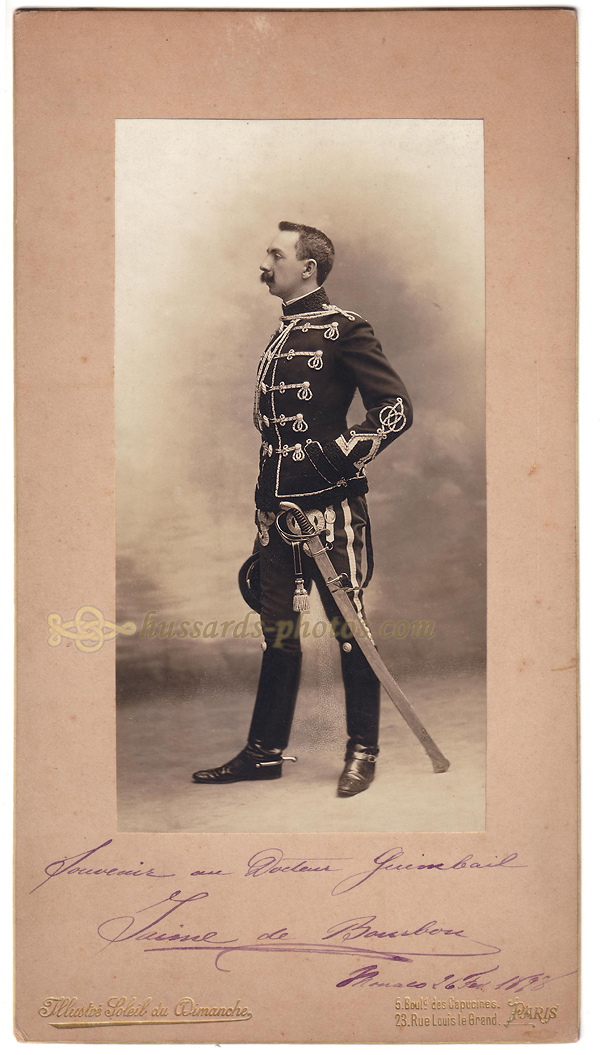
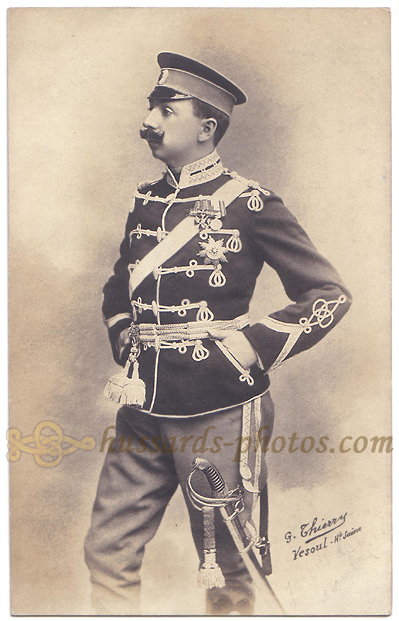
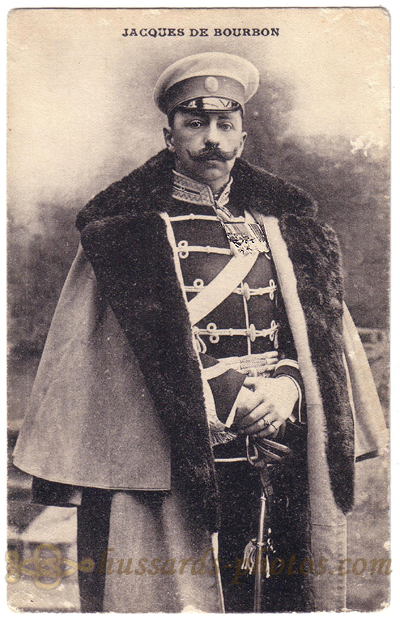
de Bourbon en Lieutenant des Hussards de Grodno
L.-Gv. Grodnenskii Gusarskii polk
Jaime (ou
'Jacques') de Bourbon est né le 27 Juin 1870 à la
Tour-de-Peilz, en Suisse.
Il est le fils aîné de Don Carlos, prétendant au trône
d'Espagne.
Il étudiera à
l'Académie Militaire de Wiener-Neustadt en Autriche
(1890-93), puis rejoindra l'Armée Impériale Russe en 1896,
comme Enseigne au 24e Régiment de Dragons de Lubny.
En 1898 il est transféré aux Hussards de la Garde de Grodno.
Le 25 Décembre 1898 on apprend au gré d'un communiqué de Don
Carlos (dont la rumeur annonçait l'abdication en faveur de
son fils) que Don Jaime est à Varsovie avec son régiment.
L'année
suivante, c'est en sportsman qu'il défraye la chronique (New
York Times, 27 Août 1899) :
"DON JAIME NOW AN AERONAUT.
SON OF SPANISH PRETENDER TRAVELS BY BALLOON IN RUSSIA.
CHICAGO, Aug. 26 - The Record's Moscow correspondant
cables the following :
"Don Jaime of Bourbon, son of Don Carlos, the Spanish
pretender, has arrived at Moscow. In company with a
small party of professional French aeronauts, he started
on a balloon voyage, traveling in the air 200 versts
(132 miles) to a village near Vladimir, where with great
difficulty a descent was made.
The party is bound for Tashkend, Turkestan, where
considerable time will be spent in hunting."
Passé
Lieutenant, il se portera volontaire pour servir en
Extrême-Orient en 1900, lors des troubles de Pékin, et le
journal Austro-Polonais "Cas" rapportera son départ
de Varsovie le dimanche 5 Août pour Tien-Tsin, via Odessa.
A Pékin la crise -qui ne dura, de célèbre mémoire, que 55
jours- sera bientôt résolue, Pékin étant reprise le 14 Août.
Ce n'est toutefois pas la fin des opérations puisque la
Russie profitera de l'occasion pour occuper la Mandchourie -
les troubles prendront fin le 16 Octobre à la signature de
l'accord de Yang-Tsé. A la fin de la campagne, Don Jaime
partira au Japon en convalescence, comme l'a relaté Pierre
Loti dans "La Troisième Jeunesse de Madame Prune" (p
128) :
"C'était dom Jaime de Bourbon, fils de dom
Carlos, et prétendant carliste au trône d'Espagne.
Engagé dans l'armée russe, il avait demandé d'aller en
Extrême-Orient, pour guerroyer, par humeur française, et
maintenant il était là, convalescent d'un typhus grave
pris en Mandchourie."
On en apprendra
un peu plus dans un article publié par The Times le
13 Mars 1901 :
'Paris, March 12
My Marseilles correspondant telegraphs :-
"The eldest son of Don Carlos, Don Jaime of Bourbon, who
took part in the Manchurian expedition and who had only
just left the Japanese hospital at Nagasaki after a
severe attack of typhus, arrived at Marseilles this
morning. Don Jaime is a lieutenant in the Russian army,
his regiment being stationed at Warsaw. he was in
Chi-Li, in the fort of Pei-tang, when the explosion
occured by which 160 Russians were killed. he wasonly
slightly bruised. Questioned as to the alleged intention
of Don Carlos to abdicate his problematic rights in
favour of Don Jaime, he said that his father had no
intention of abdicating. 'If he were to do so, however,'
he added, 'he knows that he can count on me. I shall
soon leave the Russian army to play the rôle reserved
for me by event, but while I wear the Russian uniform I
shall have nothing to do with politics. I am off now to
see my father in Venice, and thence I shall go to St.
Petersburg to see the Tsar. I follow Spanish affairs not
as a mere spectator, but as one who at a given moment
may be called personnally to take part in them.' None of
Don Jaime's countrymen met him at Marseilles."
De sa campagne
il sera récompensé par l'Ordre de Sainte-Anne de 4e Classe,
et l'Ordre de Saint Vladimir avec glaives.
On retrouvera
Don Jaime sur la Côte d'Azur en janvier 1902, où il sera
convalescent. En février, on rapporte de Nice que sa santé
est atteinte ; s'il se remet d'una ccident de voiture, c'est
surtout la diphtérie qui inquiète (sa santé est mauvaise
depuis son retour de Chine). Il se rétablira puisqu'en
Juillet cette année là, il se rendra en Serbie, visitant la
Cour à Belgrade.
En janvier 1903 c'est à Menton qu'il est signalé ; en
octobre cette année là, il fait du ballon avec l'aéro-club
de France à Saint-Cloud, en compagnie de son beau-frère, le
Grand Duc Léopold Salvator...
A partir de 1904 il est mentionné dans l'Almanach de Gotha
comme étant "à la disposition du commandant des troupes
de la circonscription militaire de Varsovie" ; voire,
avec ses multiples activités !
En 1904, les
relations entre la Russie et le Japon se durcissent à propos
de la Mandchourie, et le 10 février, c'est l'attaque de la
flotte Russe à Port Arthur, quatre jours après une
déclaration de guerre.
Le 12 Mars, le Général Kuropatkin, qui vient d'être été
nommé "Commandant de toutes les forces combattantes
s'opposant aux Japonais sur Terre et dans les mers", part
pour le front. A Saint-Pétersbourg, on annonce que Don Jaime
de Bourbon et le Prince Arsène Karageorgevitch se préparent
à partir pour l'Extrême-Orient.
Une affaire
rocambolesque précède son départ : le 28 Avril, son
secrétaire particulier, Ernest Deligne (qui s'était fait
passer pour "Comte de Spa et Prince de Ligne"
pour gagner la confiance du Prince) est condamné à dix mois
de prison pour avoir mis au clou le collier de diamants de
Marie Antoinette, héritage de Don Jaime qu'il avait prêté à
sa sœur, la princesse Alice de Bourbon. Celle-ci en avait
constaté la disparition lors d'un séjour à Spa.
Le 30 Mai, on
annonce que Don Jaime a fait une chute de cheval, mais qu'il
n'est que légèrement contusionné.
Il rejoint Niu-chwang le 23 juin, "partant immédiatement
pour le front".
The Times
relate dans son édition du 3 Août 1904 :
"Rome, Aug. 2
The Giornale d'Italia publishes several letters from Don
Jaime, son of Don Carlos. the first, dated from
Wa-fang-tien, June 9, describes the sufferings of the
Russian camp from the continual robberies of the Chinese
and the want of provisions and fodder. In another
letter, written at Lian-yang on June 18, Don Jaime again
complains of the lack of provisions. for 36 hours the
Russians had had nothing but a little tea and sugar, and
the troops kept up their strength as best they could on
tobacco and tea.
General Samsonoff, the letter continues, performed
prodigies of valour in the battles at Wa-fang-kau on
June 13, 14, and 15, when the Japanese shrapnel
literally mowed down the Russian ranks. Don Jaime
estimates the Russian killed at from 3,500 to 4,500. The
Russians lost 17 guns. They took with them in their
retreat about 1,000 wounded, many of whom, however,
died.
Don Jaime declares that the shortage of bread continues
because the depôts at Wa-fangtien were burnt in the
retreat and the Russians were not prepared for the
sudden turn taken by the events."
Le New York
Times relate (édition du 23 juillet 1904) à propos de cette
évacuation :
"TALES OF JAPANESE BARBARITY.
Paris, July 22. (...) Opinion here is incredulous on the
subject, apropos of which, however, an interesting
private letter has just been received from Don Jaime de
Bourbon.
Don Jaime, who is the eldest son of Don Carlos, the
Pretender to the Spanish throne, is serving with Gen.
Samsonoff. He relates that on evacuating Wa-fang-Tien he
drew up a proclamation in French and in big letters, in
which he mentioned two cases of mutilation and begged
the Japanese officers to restrain their men from such
uncivilized practices.
To this document Don Jaime affixed his royal signature."
Don Jaime sera
de retour à Niu-chwang fin juillet 1904 alors que
l'évacuation Russe se prépare.
Le 25 Novembre 1904, le New York Times rapporte qu'il est
décoré à Saint Pétersbourg de l'ordre de Saint-Anne par
Kuropatkin, pour "gallantry in several engagements".
Don Jaime sera à
Paris en 1909 lorsque son père décèdera et qu'il deviendra
Prétendant au trône d'Espagne. C'est l'année où il passe
Capitaine de 1ère Classe, toujours aux Hussards de grodno.
Il quittera
alors l'Armée Russe, avec le grade de Colonel et la
permission de porter l'uniforme.
Lorsque la
guerre de 1914 éclate, Don Jaime est placé aux arrêts dans
son château de Frohsdorf - officiellement pour son grade
dans l'Armée Russe, en fait pour avoir appelé ses partisans
à soutenir la France. Il lui sera donné de chosir entre la
captivité pour la durée de la guerre et l'exil - il partira
pour la Suisse.
Il finira ses jours entre l'Autriche et Paris où il décèdera
le 2 Octobre 1931. Il est enterré en Italie.
The Times
publiera sa notice nécrologique le 5 octobre :
"THE DUKE OF MADRID
SOLDIER AND TRAVELLER
The sudden death in Paris at the age of 61 of don Jaime de
Bourbon, second Duke of Madrid, almost on the morrow of
his reconciliation with King Alfonso, which was announced
in our later editions on Saturday, removes a figure of
interesting historical associations. But it was not
generally known, except to his intimate friends, that he
was a soldier, a traveller, and a man of remarkable
personality. King Alfonso visited the house on Saturday.
Born at Vevey on June 27, 1870, the only
son of Don Carlos, first Duke of Madrid, and Marguarita,
Princess of Bourbon-Parma (granddaughter of Charles X of
France), Don Jaime was but a child when his father made
his now almost legendary bid for the throne of Spain ;
though the chronicles of that campaign are not lacking
in graphic descriptions of the boundless enthusiasm with
which the boy-prince's brief visits to the battlefields
were received by the Carlist troops. He was educated
first in France, at the college of Vaugirard, and
subsequently at Beaumont ; and it is understood that
plans were mooted for his entering Sandhurst, although
political considerations caused the scheme to be
dropped. He went instead to the Austrian Military
Academy of Wiener Neustadt, and having passed his
examinations brilliantly, in 1896 entered the only army
in which the career of a soldier on active service was
open to him-that of Russia. He rose to the rank of
lieutenant-colonel in the Guards Regiment of the Grodno
Hussars. He took part with great distinction in the
Boxer Expedition and the Russo-Japanese War, showing
great bravery, notably in the battles of Pei-tang,
Liao-Yng, and Vafungon, and gaining incidentally a close
acquaintance with the Far Eastern mind, on which he was
most illuminating in conversation.
On the death of his father in 1909, when he succeeded to
the headship of the House of Bourbon, he retired from
the Russian Army, and thenceforward divided his time
principally between Paris and the Château of Frohsdorf,
in Lower Austria, which Don Carlos had inherited from
the Comte de Chambord ; though his active spirit
continually drove him to undertake extensive journeys in
all parts of the world (including Spain, which he
visited several times secretely). He did not marry, and
the position of senior prince of the House of Bourbon
now devolves upon his uncle, Don Alfonso, the younger
brother of Don Carlos, who was born in London on
September 12, 1849, and is now living in the Château of
Puchharin, in Lower Austria.
Even the bare recital of the external facts of his life
gives the indication of a singularly alert and energetic
temper, and Don Jaime did indeed accumulate a fund of
experience in various fields which, thanks to his
remarkable intelligence, made him an uncommonly
perspicacious judge of men and events, capable, too, of
an incisive expression which reminded one of his direct
ancestor, Henri Quatre. Of Spain his knowledge was
unrivalled, and his forecasts of the developments of a
political situation there were generally justified by
events. Having a first-hand experience of the horrors of
the modern battlefield, the whole idea of a civil war
was intensely repugnant to him, and he would never
countenance any schemes involving armed action in
support of his claims. A man of thoroughly modern
outlook, he represented the very antithesis to cheap
romanticism, and yet there was in him a very deep and
peculiar romantic strain. Anyone who experienced his
charming hospitality, say in the modest apartment
occupied by him in the Avenue Hoche, in Paris, could not
fail to perceive that the family portraits hanging on
the walls-a lovely vision of the Grand Dauphin, by
Nattier, a vigorous head of the Duc d'Angoulème, by
Lawrence, and many others-conveyed a definite message,
and the same was true of the touching expressions of
fidelity which ceased not to reach him from every part
of Spain. Kindly and wise, approaching interlocutors of
every shade of opinion with the same easy dignity, and
himself familiar with every variety of political
thought, he seemed a real embodiment of the tradition of
Old Europe."
Le Dolman est
vert foncé à Brandebourgs blancs.
Parmi ses décorations :
- Ordre de St.-Stanislas de 2e Classe (avec
Glaives)
- Ordre de Ste.-Anne de 3e Classe (avec Glaives)
- Ordre de St.-Vladimir de 4e Classe (avec Glaives)
- Médaille commémorative de la Campagne de Chine de 1900
- Médaille commémorative de la Guerre Russo-Japonaise
1904-1905
- Ordre de Leopold (Belgique)
- Ordre de la Couronne (Prusse)
Le Docteur
Guimbail, a qui la photo est dédicacée, semble
également être un célébrité, Henri Guimbail, qui a beaucoup
publié ; voilà quelques uns de ses travaux :
in "Annales De psychiatrie et D'hypnologie" de 1891 :
- Etude médico-légale sur Gabrielle Bompard,
Clermont (Oise)
- Etude médico-légale sur un cas de morphinomanie
conjugale : l'affaire Wladimiroff
- La dermographie
- La dyspepsie des lypémaniaques
Les
Morphinomanes (1891)
(dont les chapitres ont des titres évocateurs
: Comment on devient morphinomane / Les Prédestinés /
Ephémère volupté et supplices durables...)
La Thérapeutique Par Les Agents
Physiques (1900)
Hydrothérapie - Electrothérapie -
Thermothérapie - Frigothérapie - Kinésithérapie -
Climatothérapie - Thalassathérapie, Etc.
Loin de moi l'idée pernicieuse
d'imaginer un lien entre les sujets étudiés par le Docteur
Guimbail et son noble dédicataire !
|